Staying organized isn’t just about being “neat” it’s about protection, profit, and peace of mind. Here is your guide to mastering the pillars of business stability.
For many small business owners, “the books” are something to be feared or ignored until tax season. You might check your bank balance every morning, and if there’s a comma in the number, you feel like you’re doing great. But your bank balance only tells you what you have right now; it doesn’t tell you how you got there or where you’re going.
If you want to move from “surviving” to “scaling,” you need to master the most important document in your financial arsenal: the Profit and Loss Statement (P&L).
At Every Penny Bookkeeping & Business Services, we believe the P&L is more than just a tax document, it is a storybook of your business’s health. If you can read the story, you can change the ending.
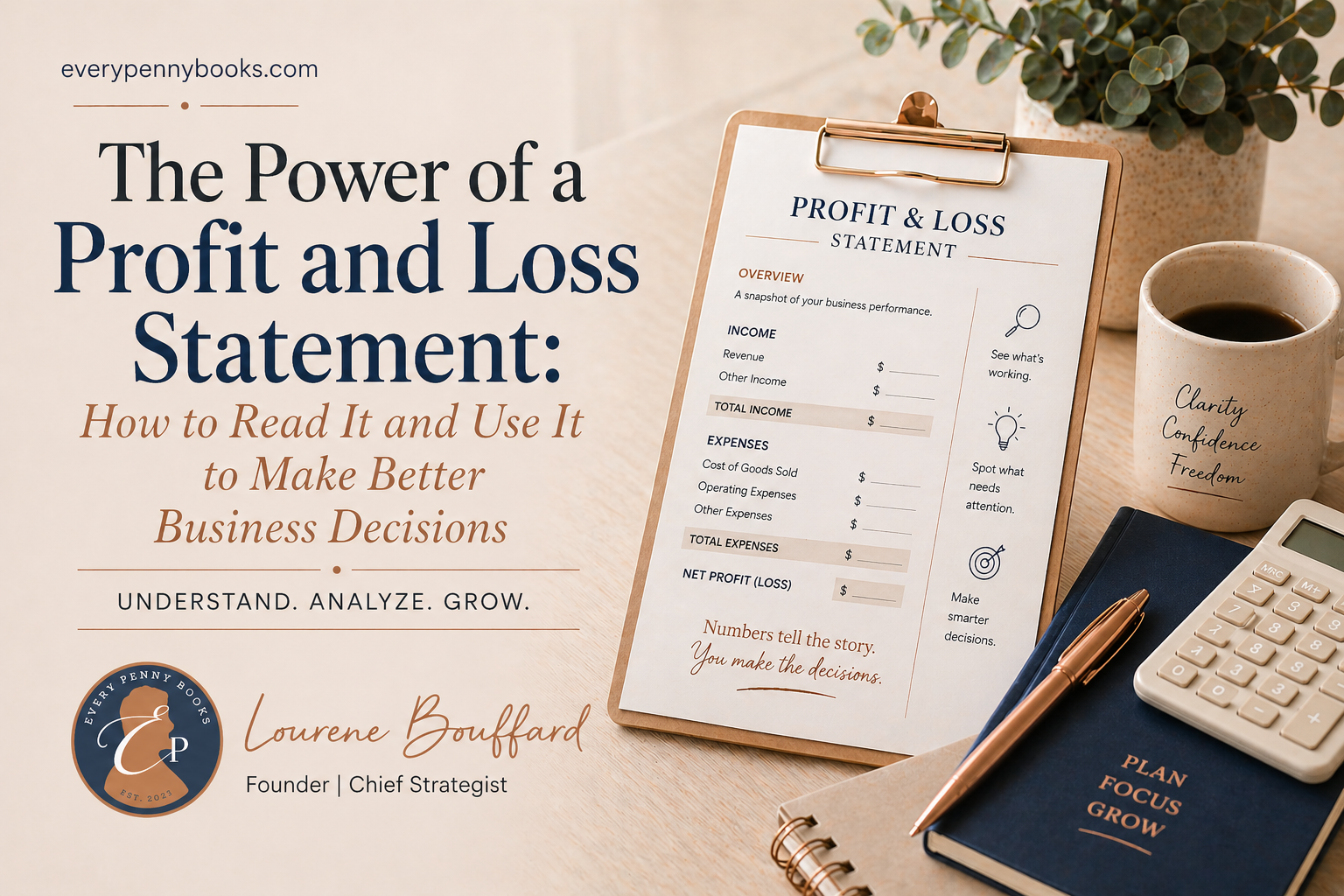
Also known as an Income Statement, the P&L summarizes your revenues, costs, and expenses over a specific period (usually a month, quarter, or year). It follows a very simple mathematical flow that every owner should memorize:
Total Income – Cost of Goods Sold – Operating Expenses = Net Profit
While that seems straightforward, the “magic” happens when you look at the subcategories. By breaking the report down into sections, it becomes a powerful map of your business performance rather than just a wall of numbers.
The P&L starts with Gross Revenue, the total amount of money your business brought in before any expenses were taken out.
How to use this for decisions: If your revenue is climbing but your bank account is staying the same, you have a “leaky bucket” somewhere in your expenses. Seeing this on your P&L allows you to stop focusing solely on “selling more” and start focusing on “keeping more.” It helps you identify which products or services are actually bringing in the most cash.
COGS includes the direct costs of producing your product or delivering your service. If you’re a baker, it’s the flour and sugar. If you’re a consultant, it might be the specific software or subcontractor used for a client project.
The Decision Point: Subtracting COGS from Revenue gives you your Gross Profit. This tells you if your pricing is correct. If your Gross Profit margin is too thin, you are working too hard for too little. This is where we often provide Business Coaching to help clients realize they need to raise their prices or negotiate better rates with vendors to protect their margins.
This section lists your “overhead”; rent, utilities, insurance, marketing, and office supplies. Unlike COGS, these expenses usually happen whether you make a sale or not.
How to use this for decisions: This is where “expense creep” happens. Look for small recurring subscriptions or administrative costs that no longer serve a purpose. A monthly P&L review forces these expenses back into your sightline, allowing you to trim the fat before it impacts your stability.
This is the “moment of truth.” It tells you exactly how much money is left to pay yourself, reinvest in the business, or save for taxes.
Once you understand how to read the statement, you can use it to make strategic, “World-Class” moves:
While AI bookkeeping tools can generate a P&L in seconds, they can’t tell you why a number looks out of place. AI might see a high “Travel” expense and categorize it correctly because the math works. An experienced human eye at Every Penny Bookkeeping & Business Services will see that same number and ask, “Wait, why did we spend $3,000 on travel when our main project this month was remote?”
We provide the Fractional CFO services that turn these numbers into a narrative. We help you find the “pennies” that turn into dollars, ensuring your financial reporting is accurate and actionable.
Your P&L is the pulse of your business. If you aren’t looking at it at least once a month, you are flying your plane in the dark. You deserve to know exactly how hard your money is working for you.
Ready to stop guessing and start growing?
At Every Penny Bookkeeping & Business Services, we don’t just send you a PDF report; we help you understand what the numbers are saying. Whether you need a cleanup of old business records, help setting up a new business, or ongoing payroll and bookkeeping, we are your strategic partners in profit.
Click here to book a call and let’s review your numbers together.
It’s time to see the true power of your own P&L.